
Legitimacy Meltdown
How Western Liberal Democracy Became an Empty Shell While China Delivers Real Democratic Substance

The latest Democracy Perception Index just dropped from the Alliance of Democracies Foundation. What makes this report interesting is that the organization publishing it was started by an ex-NATO chief and claims to unite democracies, meaning Western liberal style democracies. So it can’t be accused of having some sort of anti-Western bias. Their methodology is also straightforward, where they simply ask people if they feel their government works in their interest and whether they can hold it accountable. That’s the whole ballgame, because if people don’t believe the system is democratic then it inherently lacks legitimacy no matter what the constitution says. While people will surely attack this methodology, the sheer fact that a NATO-connected group published such a report gives its claims a certain credence given how dire these results are for the Western model of democracy. France now ranks alongside Kazakhstan, Yemen, and Zimbabwe in its own citizens’ eyes while the U.S. is split down the middle with about half of Americans saying they don’t think they live in a democracy anymore. China, on the other hand, sits up there with the Scandinavians and Switzerland, and Chinese people overwhelmingly say the system works for them. Notably, we can also see that perceptions of transparency, rule of law, and free speech are on the rise across the board in China.
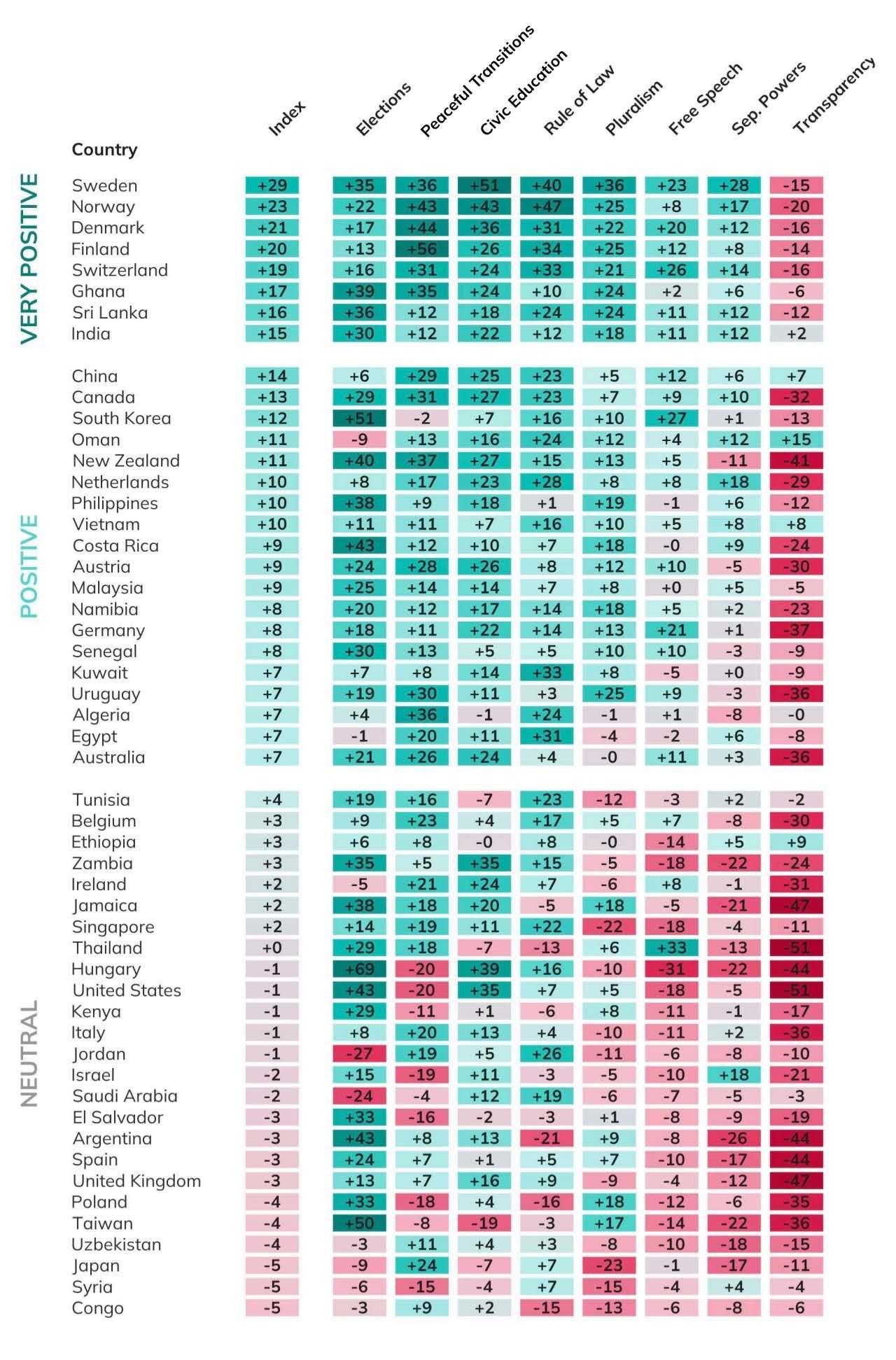
A common refrain here is to claim that people in China are simply afraid to speak their mind, yet the same report shows Russia at -21 points and Belarus at -9, so that whole excuse falls apart. Turns out that people living in states the West labels as being authoritarian do, in fact, complain when they’re unhappy.
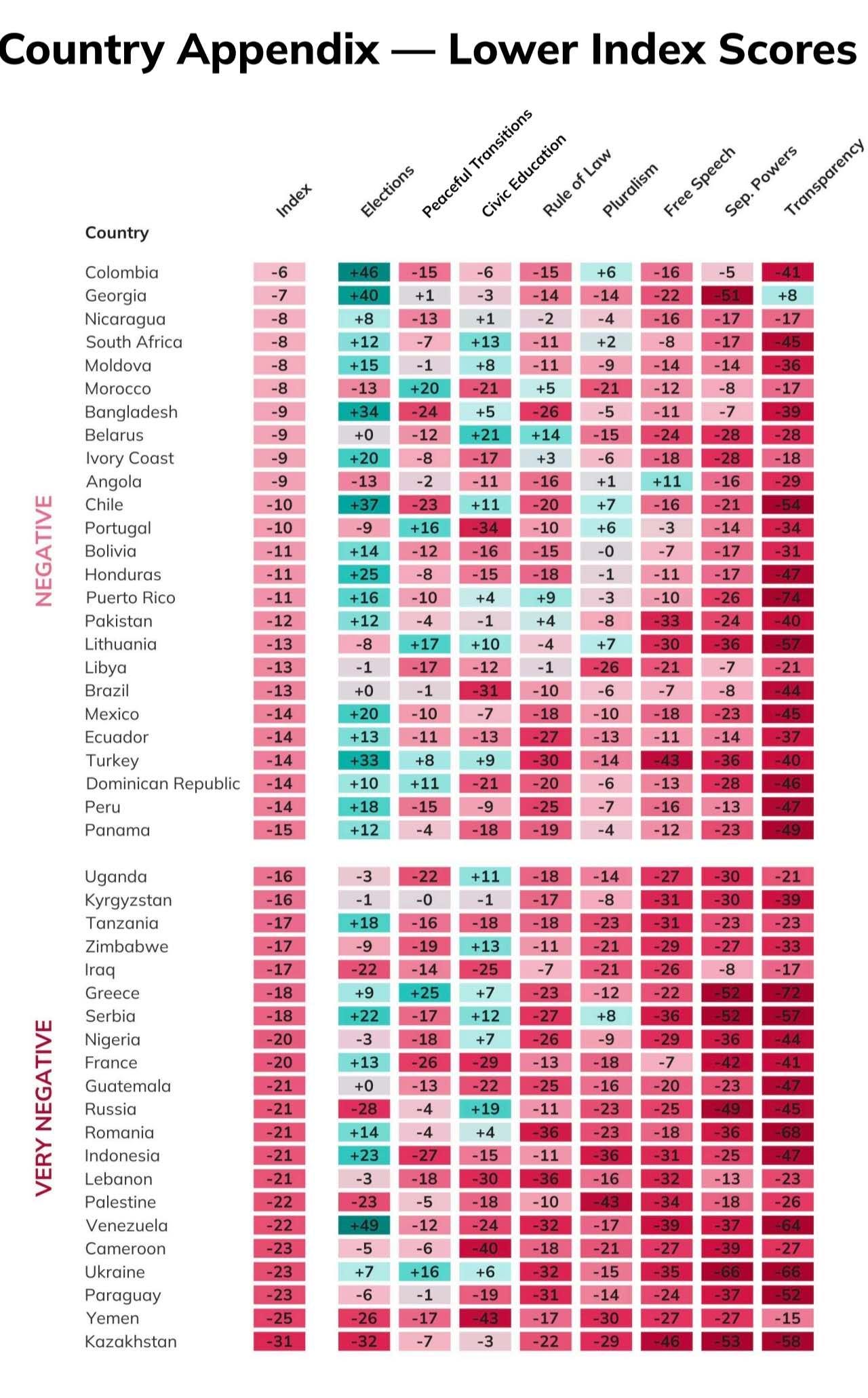
The simplest and most honest explanation here is that China’s results are real, and they’re terrifying for the West’s self-image. The report also finds that more Chinese feel they can criticize their government without consequences than Americans do. What we are seeing here is a steady geopolitical shift where the Western system continues to lose legitimacy, even in the eyes of its own citizens, while the Chinese system is starting to be seen as a valid alternative to the Western model.
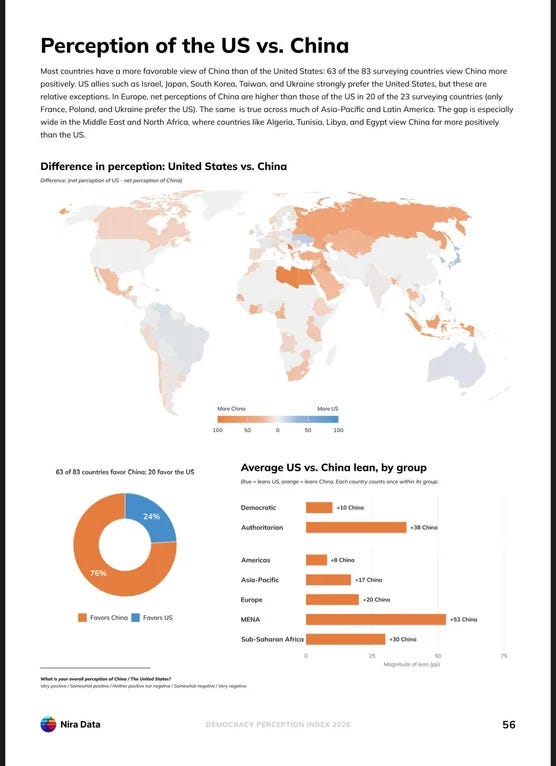
People in 83 countries were surveyed for their overall view of the United States and China with 63 of those countries (76%) holding a more favorable view of China. While countries like Israel, Japan, South Korea, and Ukraine remain exceptions, opinion across Europe, Asia‑Pacific, Latin America, and especially the Middle East and North Africa, where the gap hits +53 points in China’s favor, has pivoted decisively toward Beijing.
As the world turns away from the west and towards the east, a major reshaping of global power, economies, technology, culture, and daily life is sure to follow over the coming decades. I’ll walk you through what’s happening, the mechanics of why, and then the likely outcomes we should expect. One core insight we have to focus on is that a functional democracy isn’t about voting procedures, it has its basis in a material feedback loop between the state and the working class. When the social contract starts losing legitimacy, the whole system starts hunting for a new equilibrium, and things start to get messy as a result.
That is the key context for understanding the effects of the legitimacy meltdown that’s unfolding in societies that have embraced the Western liberal model, with the U.S. at its center. As people continue to watch their living standards fall no matter which party wins, they gradually start to realize that the game is rigged. At the end of the day, the material base continues to be the driver of the superstructure, just like diamat tells you. In countries like the U.S. where the state, being an instrument of capital, is unable to deliver secure housing, healthcare, wages that keep up, or a sense of control over the future, the working majority increasingly understands that elections in liberal capitalist society offer a choice between two managers of the same capital owning class, and so, the perception of democracy evaporates. Meanwhile, China’s state, whatever you may call it, has lifted hundreds of millions out of poverty in a single generation and now rolls out high-speed rail, green tech, and digital infrastructure that people actually use. People see their material life improve in tangible ways, and they see their complaints get addressed, which gives them the very feeling of having genuine representation. What we see in China is a functioning democratic feedback loop without the need for parliamentary elections or competing parties. While the liberal form has now become an empty shell, a so-called authoritarian system delivers genuine democratic substance to its people. And because the Alliance of Democracies Foundation is a Western-aligned institution, this data can’t be easily dismissed by the proponents of liberalism as the one true way of implementing the democratic process. The whole narrative that the West is the beacon of freedom is becoming increasingly untenable because the lived reality that people in the West experience does not bear the premise out.
Even as Western governments continue to double down on Cold War rhetoric about authoritarian threats while the U.S. State Department and Brussels churn out endless statements about resilient Western democracies, that language rings increasingly hollow for people who lost their jobs and can’t afford to make ends meet. A growing gap between the narrative and lived reality, in turn, accelerates the collapse of public trust in Western institutions themselves. We’re already seeing growing disengagement from electoral participation with voter turnouts dipping ever lower. All the while, political elites continue to dismiss public discontent as malign foreign influence, and push for stronger anti-disinformation laws instead of fixing material conditions. But increased censorship only fuels more cynicism. The irony is that state crackdowns on speech and privacy in the name of protecting democracy actually shrinks the space for dissent, making the report’s free-speech finding a self-fulfilling prophecy. For China, on the other hand, the report serves as proof that their governance model works, thus boosting the legitimacy of the Chinese system around the world.
The elephant in the room is that material conditions in the West are unable to improve in a meaningful way because of the structural drivers of these deeply financialized economies. And the resulting legitimacy crisis means that voting can no longer act as an effective pressure release valve for public anger. A key tipping point comes when a major Western European country, probably France, sees an election where the winner is so despised or opposed by the machinery of the state that they can’t govern, or the state simply ignores results. That’s already what happened in essence with Mélenchon, but imagine it even more raw and blatant. Once people see the vote as completely decorative, the system loses its last shred of magical authority. At that point a country enters an era of non-electoral politics with people having to take matters into their own hands by building mutual aid networks, organizing general strikes, then creating alternative assemblies, like the Nuit Debout or Occupy but more sustained. In response, policing will surely intensify with Western states investing heavily in surveillance using domestic extremism as the justification, creating a cycle where repression breeds resistance, which in turn breeds more repression. The Western model is increasingly becoming one of managed democracy where elections happen, but the state apparatus ensures only compliant outcomes. While some liberal intellectuals might wring their hands, most are trying to justify it as the necessary defense against populism. It is worth noting that the very notion of populism itself highlights the sheer disdain liberals have for genuine democracy.
Political instability will, in turn, lead to further economic woes as capital starts to see the West as a risky place for long-term productive investment. The smart money will look for a politically stable environment that delivers predictable returns, China being the obvious choice, but also in Southeast Asian nations that are following the same model of blending state planning with market economics. Demonstrated success will necessarily lead to more countries in Africa, Latin America, and South Asia officially pivoting to a Chinese-aligned development model. The world is rediscovering the principle that the state’s primary job is to deliver material gains for the public, and that procedural democracy is not a viable vehicle for reaching that goal.
We’re living in the last days of Western exuberance where it was assumed that there is only a single valid model of human development. And for the first time since the fall of the USSR there are again two substantively different definitions of democracy competing for global legitimacy. On the one hand we have the procedural definition held by a shrinking Western bloc, and on the other we have the substantive definition championed by China.
The younger generation in the West no longer believes the liberal story, having become deeply jaded by the system that’s visibly failing them, because everyday life in the West feels like being a frog that’s slowly getting boiled. In response, people are forced to adapt by lowering their expectations and finding meaning outside the national project.
What happens going forward rests on whether Western states can rebuild a material basis for democratic legitimacy. If they do, it’ll be because a massive social movement forces a green new deal with universal basic services and a radical restructuring of property rights, essentially a peaceful revolution that puts the economy under democratic control. In that scenario, the liberal form gets filled with socialist content as the West is forced to transform itself. But if they don’t, and the current trajectory holds, the West will formally transition into what you might call low-legitimacy high-tech oligarchies. Elections will continue as reality TV while policy will be set by a rotating cast of billionaire-derived cabinets managing the population through algorithmic welfare and police repression.
Geopolitically, much as it was during the first Cold War, the world will be dominated by two blocs both viewing themselves as internally democratic but ideologically opposed. Just as last time, we can expect a cold peace, full of proxy fights over governance of critical resources. Our global economic system will bifurcate between a planned-market hybrid with strong state coordination championed by China, and a decaying financialized system of the West. We will likely see global migration flows start moving toward the Chinese-aligned world as people increasingly seek stability and rising living standards outside the West. That would, incidentally, be an absolute inversion of the brain drain pattern that defined the 20th century.
It’s not hard to see how the loops circle back on each other. The perception report is a signal of a deeper material fault line that’s stripping away legitimacy of the Western system. And China is filling this ideological void by positioning itself as a functional alternative. The most surprising and counterintuitive outcome for champions of liberal democracy is that the Chinese political form, which Western thought labeled tyranny, ends up offering genuine democratic substance for the global working class. A key task for the Western left is to connect this shift in perception with the idea of economic democracy. A major risk those of us living in the West face is one of sliding into fascism leading to a hot war with China, or a breakdown of global trade that tips the world into a depression so deep that billions suffer.
We are entering a period of rapid geopolitical realignment which is sure to destabilize the world in the near term because the foundational myth of the US-led order has now been shattered beyond repair. It’s increasingly hard for people to believe in the notion of a liberal procedural democracy having any sort of unique legitimacy. As the myth dies, its death throes are going to be violent and unpredictable. But that destabilization isn’t going to last forever, and it will clear space for a more honest and materially grounded understanding of what democracy means. If we are lucky and smart, the long-term trajectory could be a world where the standard of legitimacy is not a ballot in a rigged system but a measurable improvement in people’s lives, with tangible and functional feedback mechanisms. Such a world would be more stable simply because it’s built on observable reality rather than a fading story of Western supremacy.
Take out election and separation of powers, which are mostly pointless western style exercises in giving people the illusion of democracy and China will get even higher.